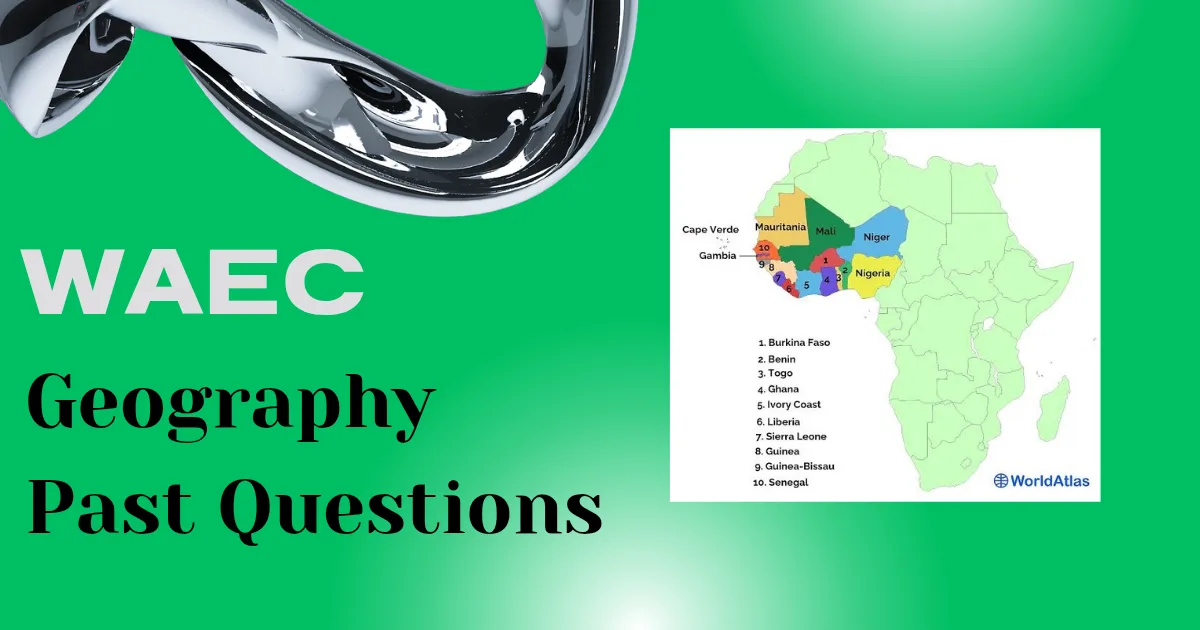
Geography WAEC Past Questions: with 2025 Questions and Answers
I want you to take this article as me pouring my heart for you to get it right. Geography is one of the most important subjects in the West African Examination Council (WAEC), especially for students interested in environmental science, urban planning, geology, and social sciences. WAEC Geography tests both theoretical understanding and practical interpretation skills such as map reading, data analysis, and environmental reasoning.
This article provides a comprehensive guide to WAEC Geography past questions, including a detailed explanation and complete answers to typical WAEC 2025 Geography questions (excluding practical map work). It is structured to help students understand question patterns, master key topics, and improve performance in the examination.
Understanding the Structure of WAEC Geography
Before I delve deep I want you to first understand that Geography is not as difficult as you think. It is usually divided into three main sections:
Section A (Objective Questions) which are multiple choice questions covering the entire syllabus.
Section B (Theory, Physical & Human Geography) and contains Essay-type questions.
Section C (Regional Geography or Applied Geography) which contain Questions on Africa and global geography topics.
You are expected to answer a combination of questions from these sections, demonstrating both factual knowledge and analytical skills.
Key Topics Frequently Tested in Geography WAEC Past Questions
As someone who studied Geography very well and had good grade in WAEC I will assure you that WAEC tends to repeat certain core topics every year. These include:
Earth structure and landforms
Weather and climate
Vegetation and soils
Population and settlement
Agriculture and industry
Transportation and trade
Environmental issues (erosion, desertification, pollution)
If you Understand these topics deeply it gives you strong advantage when answering past questions.
Geography WAEC Past Questions and Answers for 2025
Below are carefully reconstructed WAEC 2025 Geography theory questions along with detailed answers.
Question 1:
Explain the Processes of Weathering
Answer:
Weathering refers to the breakdown of rocks in situ (in their original position) without movement. It occurs through three main processes:
Physical (Mechanical) Weathering
This involves the disintegration of rocks without chemical change.
Causes include temperature changes, frost action, and pressure release.
Example: In hot regions, rocks expand during the day and contract at night, leading to cracking.
Chemical Weathering
This involves the decomposition of rocks due to chemical reactions.
Processes include oxidation, carbonation, hydrolysis, and solution.
Example: Limestone dissolves in rainwater containing carbon dioxide.
Biological Weathering
Caused by living organisms such as plants, animals, and humans.
Tree roots can penetrate cracks and widen them.
Burrowing animals also contribute to rock breakdown.
Importance of Weathering:
Formation of soil
Supply of minerals
Landscape development
Question 2:
Describe the Types of Rainfall
Answer:
Rainfall is the process by which water falls from the atmosphere to the earth’s surface. The three main types are:
Convectional Rainfall which Occurs in hot regions. The sun heats the earth, causing air to rise, As the air rises, it cools and condenses into clouds, leading to rainfall and it is Common in equatorial regions.
Orographic (Relief) Rainfall which Occurs when moist air is forced to rise over mountains. As it rises, it cools and condenses. Rain falls on the windward side, while the leeward side experiences a rain shadow.
Cyclonic (Frontal) Rainfall which Occurs when warm and cold air masses meet. The warm air rises over the cold air, cools, and condenses and it is Common in temperate regions.
Question 3:
Explain Factors Affecting Population Distribution
Answer:
Population distribution refers to how people are spread across the earth’s surface. Factors influencing it include:
Physical Factors
Climate: Moderate climates attract more people.
Relief: Flat areas are more populated than mountainous regions.
Soil fertility: Fertile land encourages settlement.
Economic Factors
Availability of jobs
Industrial development
Trade opportunities
Social and Political Factors
Government policies
Security and stability
Availability of social amenities (schools, hospitals)
Historical Factors
Past migration patterns
Colonial influences
Question 4:
Discuss the Importance of Agriculture in West Africa
Answer:
Agriculture plays a vital role in West Africa, such role include
1. Food Supply
Agriculture provides food for the population. Such include yam, cassava, rice, and maize.
2. Employment
Employs a large percentage of the population.
3. Raw Materials
Supplies raw materials to industries (e.g., cotton for textiles).
4. Foreign Exchange
Export crops like cocoa, groundnuts, and palm oil generate income.
5. Rural Development
Encourages infrastructure development in rural areas.
Question 5:
Explain Causes and Effects of Soil Erosion
Answer:
I will list some of the causes and Effects for you to research on their explanations.
Causes are:
Heavy rainfall
Deforestation
Overgrazing
Poor farming practices
Effects are:
Loss of fertile soil
Reduced agricultural productivity
Desertification
Siltation of rivers
Control Measures:
Afforestation
Terracing
Crop rotation
Contour ploughing
Question 6:
Describe Transportation Systems and Their Importance
Answer:
Transportation refers to the movement of people and goods from one place to another.
Transportation Types include:
- Road transport
- Rail transport
- Water transport
- Air transport
Importance of Transportation are:
Facilitates trade
Promotes national unity
Encourages economic development
Aids tourism
Question 7:
Explain Urbanization and Its Problems
Answer:
Urbanization is the movement of people from rural areas to cities.
Causes for Urbanization are:
Job opportunities
Better education and healthcare
Industrialization
Problems include:
Overcrowding
Unemployment
Pollution
Housing shortage
Solutions:
Rural development
Provision of infrastructure
Urban planning
Question 8:
Describe Vegetation Zones in Africa
Answer:
Africa has several vegetation zones:
Equatorial Forest
Dense forests
High rainfall
Savanna Grassland
Tall grasses and scattered trees
Seasonal rainfall
Desert Vegetation
Sparse vegetation
Low rainfall
Mediterranean Vegetation
Shrubs and short trees
Found in North and South Africa
How to Effectively Use WAEC Geography Past Questions
Studying past questions is one of the most effective strategies for passing WAEC Geography, like I have earlier said Geography is not as difficult as you think. Here is how to maximize studying Geography Past Questions:
Practice regularly: Solve at least one full paper weekly.
Understand marking schemes: Focus on how answers are structured.
Study diagrams: Geography often requires labeled illustrations.
Time yourself: Practice under exam conditions.
Revise weak areas: Identify and improve on difficult topics.
Common Mistakes You Should Avoid in Your Geography WAEC Exam
Many students fail Geography not because it is difficult, but due to avoidable mistakes:
Writing vague answers
Not using diagrams where required
Poor time management
Lack of examples in essays
Ignoring command words like “explain,” “describe,” and “outline”
Tips for Scoring High in WAEC Geography
I will outline some of the tips that could make you to score high in your Geography WAEC Exam.
Use clear headings in essays
Support answers with examples
Draw neat and labeled diagrams
Be concise but detailed
Revise key definitions and concepts
FAQ’s About Geography WAEC Past Questions
Here are few questions which you can also practice towards your coming exam
Physical Geography
1. What are the three major types of rainfall? Explain each.
Answer: Convectional, Relief/Orographic, Frontal rainfall
2. What is the difference between rotation and revolution of the earth?
3. What instrument is used to measure humidity / wind direction / sunshine duration?
Answers: Hygrometer, wind vane, sunshine recorder
4. Explain the formation of fold mountains and give 2 examples in Africa.
5. What is leaching and in which climate does it occur most?
Answer: Downward transport of dissolved minerals in humid climates.
Human Geography
6. Explain 5 causes of rural-urban migration in Africa.
Answer : some of the causes areJobs, education, healthcare, infrastructure, social amenities
7. Discuss 4 effects of climate change on agriculture in West Africa.
Answer : Unpredictable rain, drought, crop yield loss, flooding but you must discuss them in detail.
8. List and explain 4 problems of urbanization in Nigeria.
9. Give 4 reasons why countries exchange goods and services.
10. What are 3 advantages and 3 disadvantages of road transportation?
Map Work & Nigeria
11. On an outline map of Nigeria, locate: Chad Basin, Western Highlands, River Niger, Kanji Dam.
12. Name 3 vegetation belts in Nigeria and describe effects of climate on one.
13. Draw a sketch map of Nigeria showing one area of high population density and one of low density. Give reasons.
14. List 4 mineral deposits in Nigeria and one town where each is mined.
Answer : Tin-Jos, Limestone-Ewekoro, Oil-Port Harcourt
15. What factors have helped the development of Lagos seaport? What 2 factors limit its use?
I also wrote some beautiful waec articles which you can check out now:
- WAEC Chemistry Past Questions
- WAEC 2026 Chemistry Syllabus
- WAEC Syllabus for Civic Education 2026
- WAEC Mathematics Syllabus 2026/2027 Fully Explained
- WAEC 2026 English Language Syllabus
- How to Pass WAEC 2026 in One Sitting (Proven Guide)
- WAEC 2026 Biology Syllabus [Science]
- 2026 WAEC Geography Syllabus (Complete Guide for Students)
- WAEC 2026 Syllabus for Agriculture
- WAEC 2026 Physics Syllabus
- Commerce Syllabus for WAEC 2026/2027 Academic Session
- WAEC 2026 Result Checker: How to Check Online and Via SMS
- When Will WAEC 2026 Result Be Out? See Latest Update Here
- WAEC Marketing Syllabus 2026/2027 Exam
- WAEC GCE 2026 Form: Registration, Price and Closing Date
- WAEC 2026 Financial Accounting Syllabus
- WAEC 2026 Timetable PDF Download (For All Subjects)
Conclusion
WAEC Geography is a subject that rewards understanding, consistency, and practice. By studying past questions and mastering frequently tested topics such as weathering, rainfall, population, and agriculture, students can significantly improve their chances of success.
The 2025 WAEC Geography questions highlight the importance of core geographical concepts and their real-world applications. Students who prepare thoroughly using past questions, structured answers, and proper revision techniques will not only pass but excel in the examination.
To succeed, focus on clarity, accuracy, and consistent practice, then Geography will become one of your strongest subjects.